
When your jaw constantly feels tight, the usual advice is to “stop clenching” or “try to relax.”
That sounds simple. But for someone with joint hypermobility, relaxing the jaw may not feel simple at all.
Sometimes, the muscles around a hypermobile joint work harder because the body is trying to create stability. In the jaw, that extra muscular effort may feel like persistent tightness, fatigue, soreness, clenching, headaches, or tension that travels into the face and neck.
Your body is not necessarily working against you. It may be trying to support a joint that does not feel as stable as it should.
First, your jaw is a joint too
The temporomandibular joints, commonly called the TMJs, are located just in front of your ears. They connect your lower jaw to your skull and help you speak, chew, yawn, and open and close your mouth.
TMJ refers to the joint itself. TMD, or temporomandibular disorder, is the broader term for conditions that affect the jaw joint, chewing muscles, and surrounding tissues.
Common TMD symptoms can include:
- Pain in the jaw joint or chewing muscles
- Facial or neck pain
- Jaw stiffness or fatigue
- Painful clicking or popping
- Limited movement or locking
- Headaches associated with jaw tension
It is worth noting that painless clicking or popping can be common and does not always require treatment. Pain, locking, changes in movement, or symptoms that interfere with eating and speaking deserve more attention. (NIDCR)
What does hypermobility mean?
Hypermobility means that one or more joints move beyond the range typically expected for that joint.
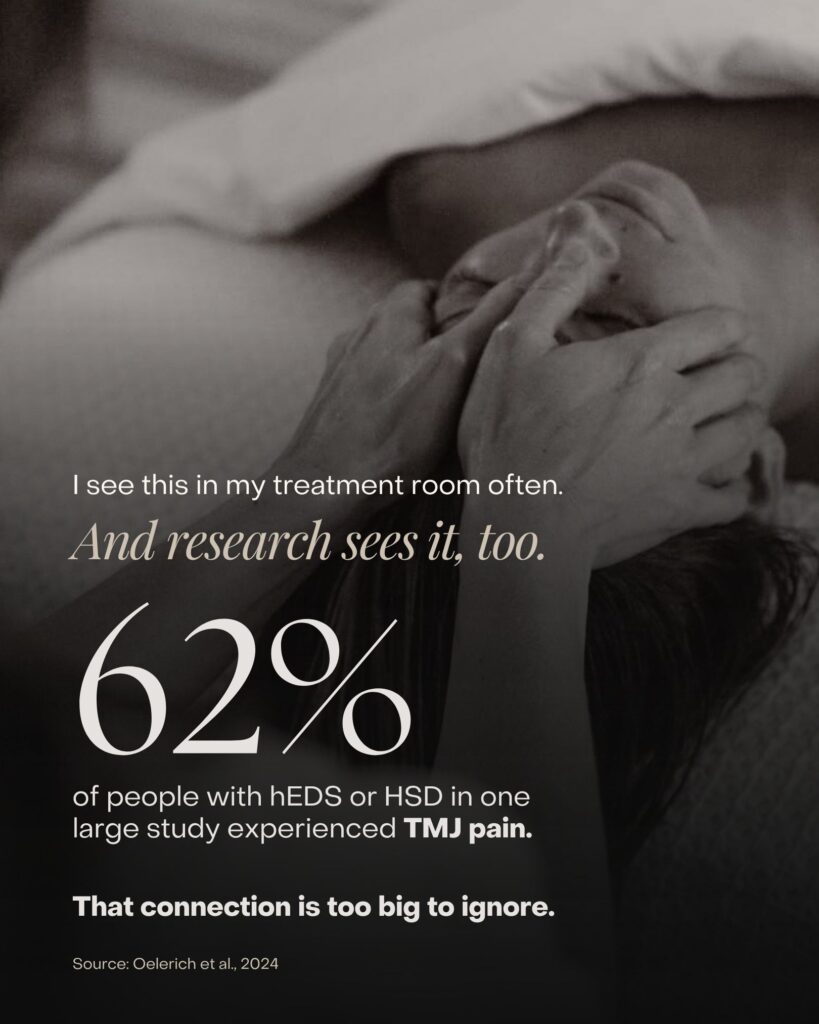
Some people are naturally flexible and have no pain or instability. For others, hypermobility is associated with symptoms and may occur as part of a hypermobility spectrum disorder, or HSD, or hypermobile Ehlers-Danlos syndrome, or hEDS.
These are connective-tissue conditions associated with joint hypermobility, instability, injury, and pain. Connective tissue includes structures that help support the joints, such as ligaments, tendons, and joint capsules. (Ehlers-Danlos Society)
This does not mean that every flexible person has HSD or hEDS. It also does not mean that jaw pain automatically points to a connective-tissue disorder.
Hypermobility is one possible piece of a much larger picture.
How can hypermobility affect the jaw?
A joint needs both mobility and control.
When the structures surrounding a joint provide less passive stability, the nervous system may rely more heavily on the nearby muscles to control movement. Around the jaw, that can involve the masseter, temporalis, pterygoid muscles, and muscles connecting the jaw, neck, and upper shoulders.
Those muscles may remain active even when you believe you are resting.
You might notice:
- A jaw that feels tight almost all the time
- Soreness after talking or chewing
- Clenching during concentration or stress
- Jaw fatigue by the end of the day
- Clicking, popping, or shifting
- Headaches near the temples
- Tension through the cheeks, neck, or shoulders
- A feeling that the jaw is difficult to “settle”
- Episodes of locking or excessive movement
Research supports a meaningful connection between Ehlers-Danlos syndromes and temporomandibular disorders, although the available studies vary considerably in their methods, populations, and reported prevalence. A 2024 review found a high prevalence of TMD symptoms across EDS subtypes while also emphasizing that more research is needed to understand effective, long-term treatment. (PubMed)
In one study involving people with classical or hypermobile EDS, at least 49.2% reported painful or restricted jaw movement, while 84.9% reported pain in the chewing muscles. These numbers should not be treated as universal estimates, but they help show that jaw and facial symptoms are not unusual within this population. (PubMed)
A more recent scoping review found that generalized joint hypermobility may be associated with TMJ hypertranslation and certain TMD presentations. However, researchers also noted that there is still no clear consensus on how TMJ hypermobility should be defined and measured. (PubMed Central (PMC))
In other words: the connection is important, but it is not as simple as saying that hypermobility automatically causes TMD.
Why “just relax” may not work
Jaw tension is not always a conscious choice.
You may genuinely try to unclench, only to notice that your jaw tightens again a few minutes later. Stress and nervous-system arousal can certainly contribute, but they may not be the only factors.
For a person with hypermobility, muscular tension may also be serving a protective purpose. The body may perceive that it needs additional support around the joint, so it maintains a certain amount of muscular guarding.
That does not mean more tension is always helpful. Over time, continuous muscle activity may contribute to soreness, fatigue, tenderness, headaches, and reduced comfort during everyday activities.
It simply means that the goal may not be to force the muscles to “let go” all at once. A more thoughtful approach considers comfort, control, breathing, nervous-system regulation, surrounding neck tension, and the individual stability needs of the jaw.
Stress can still be part of the picture
Understanding the role of hypermobility does not mean dismissing stress.
Jaw symptoms are often influenced by several overlapping factors. The National Institute of Dental and Craniofacial Research notes that genes, life stressors, psychological factors, injuries, and differences in pain processing may all play a role in the development or persistence of TMD. (NIDCR)
Stress may increase clenching or make existing tension feel more intense. Poor sleep, long hours at a computer, frequent gum chewing, prolonged talking, and certain movement habits may also contribute.
Your symptoms do not have to come from one single cause to be real.
Can TMD massage help?
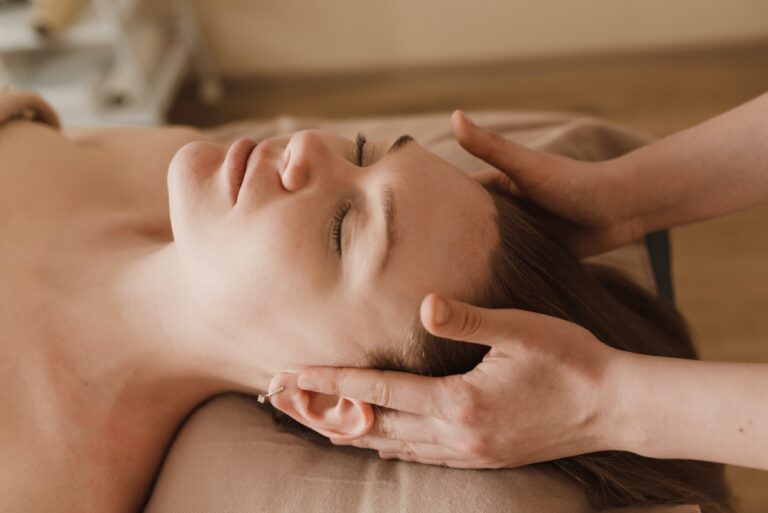
Therapeutic massage and manual care may help address the muscular portion of jaw discomfort.
A personalized TMD massage session may focus on areas such as the:
- Masseter muscles
- Temporalis muscles
- Muscles beneath and around the jaw
- Neck and upper shoulders
- Scalp and facial tissues
- Intraoral muscles, when appropriate and performed with consent
The purpose is not to force a hypermobile joint farther into its range. In fact, an overly aggressive approach may be uncomfortable for someone who already experiences instability.
Instead, treatment may focus on calming overworked muscles, reducing protective tension, improving awareness of clenching patterns, and helping the jaw and surrounding tissues feel more comfortable.
Research examining manual therapy for TMD suggests that it may improve pain and jaw function for some patients, particularly when combined with appropriate exercise, education, and other conservative care. However, results vary by technique, and manual therapy should not be presented as a guaranteed cure. (PubMed)
For someone with known or suspected hypermobility, the pressure, range of motion, and treatment plan should be adapted to the individual rather than following a one-size-fits-all routine.
When should you speak with a medical or dental provider?
Massage can be a valuable part of supportive care, but it does not replace an evaluation from a qualified medical or dental professional.
Consider speaking with a dentist, physician, physical therapist, or other appropriate provider when you experience:
- New or worsening jaw pain
- Repeated locking or dislocation
- Difficulty opening or closing your mouth
- Significant changes in your bite
- Swelling, numbness, or unexplained facial pain
- Symptoms following an injury
- Pain that affects eating, sleeping, or speaking
- Concerns about HSD, hEDS, or another connective-tissue condition
There is no single standard test that diagnoses every form of TMD. A provider may need to review your medical history, examine the head, jaw, face, and neck, and rule out other possible causes of your symptoms. (NIDCR)
A gentle reminder
This article is educational and is not an attempt to diagnose TMD, joint hypermobility, HSD, hEDS, or any other medical condition.
Jaw tension can have many possible causes, and having one or more of the symptoms described here does not confirm that you have a hypermobility-related disorder.
But if you have always been unusually flexible, have a known hypermobility condition, or feel that your jaw muscles are constantly working overtime, that information may be worth sharing with the professionals involved in your care.
You deserve an approach that considers the whole picture—not one that simply tells you to relax harder.
TMD massage and jaw-pain support in Orlando
Located in Orlando, Exhale Massage specializes in TMD massage and therapeutic care for jaw pain, facial tension, and stress-related discomfort.
Whether you are experiencing long-standing symptoms or a recent onset of tension, each session is designed to provide personalized, thoughtful care in a calm and supportive environment. For clients with hypermobility or sensitivity around the jaw, treatment can be adjusted to prioritize comfort and avoid unnecessarily aggressive stretching or pressure.
Experiencing jaw tension, facial pain, clenching, or recurring headaches? Schedule a personalized TMD massage session with Exhale Massage Orlando.