
Have you ever caught yourself driving home from a long day, shoulders up around your ears, teeth pressed firmly together — and not even realized it? Or maybe you’ve woken up with a sore jaw and no idea why? You’re not imagining things. Your body, and your jaw in particular, has a way of holding onto stress long after the stressful moment has passed.
At Exhale Massage Orlando, we talk to clients about this connection all the time. The link between stress, anxiety, and TMJ dysfunction is one of the most underappreciated conversations in wellness — and once you understand it, so much about your body starts to make sense.


The Jaw Is an Emotional Barometer
Think about the phrases we use every day: grit your teeth, bite your tongue, clench your jaw. Language has always known what science is now confirming — the jaw is one of the places the body carries emotional tension.
The temporomandibular joint (TMJ) connects your lower jaw to your skull just in front of each ear. It’s surrounded by a dense network of muscles — the masseter, temporalis, and pterygoids — that are among the most powerful in the human body relative to their size. When you’re anxious, overwhelmed, or chronically stressed, these muscles are often the first to quietly tighten and hold. Over time, that holding becomes habit. And habit becomes pain.
What the Research Tells Us
The connection between psychological stress and jaw disorders isn’t just anecdotal — it’s well established in the scientific literature.
A 2022 systematic review published in Frontiers in Psychiatry (Santos et al.) specifically investigated whether there is a meaningful association between temporomandibular disorders and anxiety. The researchers concluded that anxiety stands out as a comorbidity frequently tied to TMJ disorders — capable of changing pain sensations and triggering the release of neurotransmitters linked to parafunctional habits like teeth grinding and clenching.
A 2025 review published in The Journal of Headache and Pain described the relationship through the lens of the biopsychosocial model, noting that TMDs often coexist with mental health conditions — particularly depression and anxiety — in ways that create a cycle: psychological distress worsens jaw pain, and chronic jaw pain, in turn, worsens psychological distress.
A 2024 systematic review in the Journal of Oral Rehabilitation (Machado et al.) found that roughly half of the studies reviewed reported a positive association between occupational stress and TMD diagnosis across a wide range of job categories — meaning it doesn’t matter what kind of work you do, stress shows up in the jaw.
And a particularly telling study published in Scientific Reports found that among patients with painful TMD, clenching habit was the single strongest predictor of worsening depression scores — even outpacing factors like pain intensity and muscle stiffness. The jaw and the mind are deeply intertwined.
The Stress–Clench–Pain Cycle
Here’s how it tends to unfold:
Stress or anxiety arrives. Your nervous system shifts into a mild fight-or-flight response. Muscles tighten, breathing shallows, the jaw closes and holds.
The habit forms quietly. You start clenching during the workday without noticing. Maybe you grind at night. The masticatory muscles — already overworked — become chronically fatigued and tender.
Symptoms appear. Headaches. Jaw soreness in the morning. A clicking sound when you eat. Neck tension that won’t quit. Earaches with no infection. These feel unrelated, but they’re all telling the same story.
The pain feeds the stress. Living with chronic discomfort is exhausting and demoralizing. Sleep suffers. Mood dips. And the cycle continues.
The good news? This cycle can be interrupted. That’s exactly where TMJ release massage comes in.
How Massage Breaks the Cycle
TMJ release massage works on two levels simultaneously — and that’s what makes it so effective for stress-related jaw dysfunction.
Physically, it releases the tight, overworked muscles of the jaw, face, and neck. Trigger points — those dense, hyperirritable knots that refer pain to the temples and ears — are addressed directly. Circulation increases. Range of motion improves. The joint has room to decompress.
Neurologically, massage activates the parasympathetic nervous system — the “rest and digest” counterpart to the fight-or-flight response. This is the same mechanism that slows your heart rate, deepens your breathing, and tells your nervous system it’s safe to let go. When your body gets that signal, muscles that have been braced for stress finally release — sometimes for the first time in months.
The result isn’t just a jaw that feels better. It’s a whole-body exhale. (Which, fitting enough, is exactly the experience we aim to create.)
Signs That Stress Is Living in Your Jaw
You might be surprised how many common complaints trace back to stress-related TMJ dysfunction. Here are some signs worth paying attention to:
- You wake up with jaw soreness or headaches
- You catch yourself clenching during the day — at your desk, in traffic, during hard conversations
- Your partner has mentioned you grind your teeth at night
- You have recurring tension headaches, especially at the temples or behind the eyes
- Your neck and shoulders feel chronically tight, even after regular massage
- You hear clicking or popping when you chew or open your mouth wide
- You experience a vague earache or sense of fullness that isn’t an infection
- Stressful periods in your life seem to make all of the above worse
If you nodded along to more than a couple of those, your jaw has been trying to get your attention.
What a TMJ Release Session Feels Like at Exhale
We know the idea of someone working on your jaw might sound a little unfamiliar. We want you to know it’s one of the most deeply relaxing sessions we offer — once clients experience it, they wonder how they ever went without it.
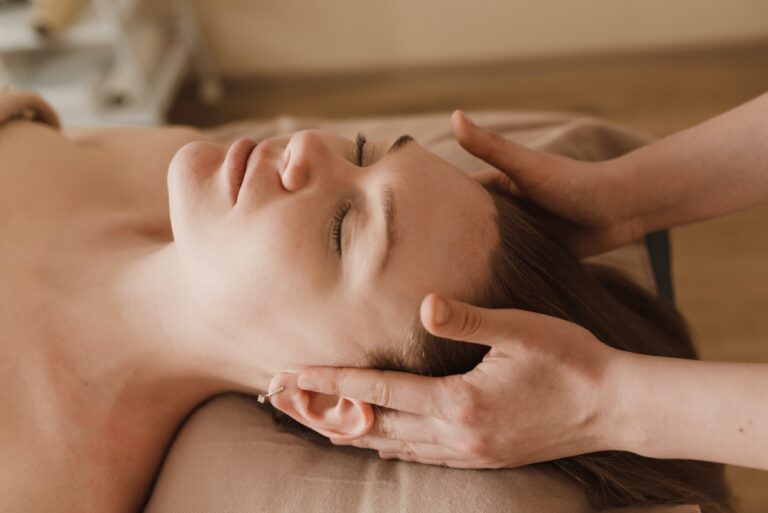
Your therapist will start by releasing the neck, shoulders, and upper back, because the jaw doesn’t exist in isolation. From there, they’ll move into the facial muscles — the masseter along your jawline, the temporalis at your temple, and surrounding areas where tension likes to hide. The pressure is firm but never forceful, and you’ll be guided through everything at your own pace. Many clients are surprised by how much tenderness they discover in areas they didn’t realize were holding tension.
By the end of the session, most people describe feeling like a weight they didn’t know they were carrying has been set down.
A Few Things You Can Do Between Sessions
Massage does the heavy lifting, but a few daily habits can support your jaw health between appointments:
Notice the clench. Set a reminder on your phone a few times a day to check in with your jaw. Teeth should rest apart, with lips gently closed. If they’re pressed together, let them relax.
Watch what you’re eating. During flare-ups, give your jaw a break from hard, chewy foods. Chewing gum is especially hard on an already-stressed jaw.
Apply warmth. A warm compress on the jaw for 10–15 minutes can ease muscle fatigue and encourage relaxation.
Slow your breathing. When you notice stress rising, a few slow, deep exhales signal to your nervous system that the threat has passed — and your jaw muscles will respond accordingly.
You Deserve to Feel Like Yourself Again
If you’ve been living with jaw tension, chronic headaches, or the kind of full-body tightness that never quite goes away, please know that it doesn’t have to be your normal. Stress has a way of accumulating quietly in the body, and the jaw is one of its favorite hiding places. But it also responds beautifully to the right kind of care.
We’d love to be part of your unwinding. Book your TMJ release session at Exhale Massage Orlando and give your jaw — and your nervous system — the release they’ve been waiting for.
References
Santos, E.A., et al. (2022). Association between temporomandibular disorders and anxiety: A systematic review. Frontiers in Psychiatry, 13, 990430. https://doi.org/10.3389/fpsyt.2022.990430
Machado, C.A.O., et al. (2024). Association between Stress at Work and Temporomandibular Disorders: A Systematic Review. Journal of Oral Rehabilitation, 51(10), 2220–2233. https://doi.org/10.1111/joor.13794
Lee, Y.H., & Auh, Q.S. (2022). Clinical factors affecting depression in patients with painful temporomandibular disorders during the COVID-19 pandemic. Scientific Reports, 12, 14667. https://doi.org/10.1038/s41598-022-18745-0
The Journal of Headache and Pain (2025). Temporomandibular disorders and mental health: shared etiologies and treatment approaches. https://doi.org/10.1186/s10194-025-01985-6